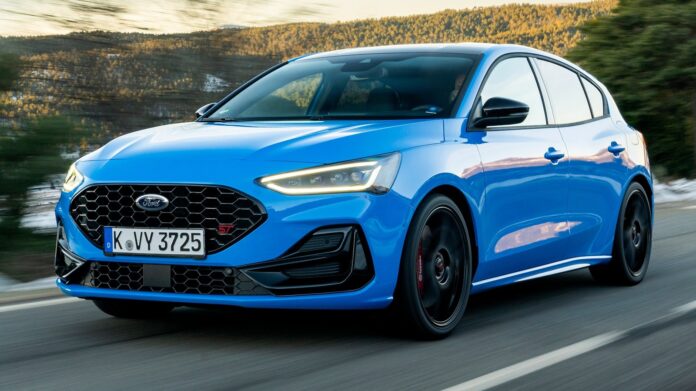

The Ford Focus first launched in Europe in 1998, before making its American debut 2 years later in 2000. You could get it in multiple styles, including a sedan or wagon, but arguably the most popular rendition was the hatchback, which also found a sizeable audience in Europe. The automaker eagerly pushed the car toward younger drivers, but its youth-focused ad campaign was perhaps a bit too much, as Ford Focus brochures from the early 2000s are full of cringe.
The early 2000s also saw the release of the SVT hatchback version, which included a manual gearbox and a 2.0-liter 4-cylinder under the hood that pumped out 170 horsepower. This bumped up output significantly over other iterations. The Ford Focus was affordable, fun to drive, and sold well in the U.S., with Edmunds showing that Ford moved a total of 245,922 units in 2012.
However, in the years following, the Ford Focus began waning in popularity Stateside. As sales continued in a downward trend, Ford pulled the plug in 2018, but only in the American market. The Focus lived on in Europe until late 2025. So, if the public wasn’t buying the Focus as much, what were they driving? During the production life of the Focus, a new player to the industry rose dramatically, the crossover. The growing popularity of crossovers, as well as other factors like Ford’s EV investments, caused the automaker to discontinue the Focus.
Crossovers gain market share
While the Ford Focus (especially the hatchback), provided more interior space than you may think, buyer tastes started to change, leaning into a desire for greater functionality. Looking at market data of the past few decades, you can see a big shift in vehicle preference among Americans. According to data from Wards Intelligence, highlighted by Consumer Reports, the crossovers market share went from a low single digit percentile at the turn of the century to almost 40% 18 years later. Small crossovers are catching up to big trucks among America’s best-selling vehicles. The most popular crossovers by 2025 were the mid-size models, capturing 46.8% of the segment, per Future Market Insights. These vehicles offer more cargo room than the Focus, and, in some cases, they provide higher-quality interiors and turbocharged engines, making them functional and fun.
Another advantage the Focus had at the start of its run was its generous fuel economy, with even the first SVT performance model achieving 28 mpg city and 36 mpg highway figures. According to Car and Driver tests, the 2018 Focus managed 38 mpg, gently sipping fuel and saving drivers money. However, advances to engine design have produced increasingly more efficient vehicles over the last several years, allowing for all types of automobiles (including crossovers) to benefit. Take a popular crossover like the Honda CR-V, for instance. The turbocharged gas engine version achieves an EPA estimated 28 mpg in the city and 33 mpg on the highway, while the hybrid iteration manages a combined 40 mpg.
Ford changing directions
Back in 2018, NPR reported some big changes to Ford, which included pivoting its plant in Chicago from cars to SUVs, ceasing production of several models, and sinking $11 billion into its EV program. Today, the only new car you can purchase from the automaker is the Mustang, with the rest of its roster made up of crossovers, SUVs, and pickups. Ford offers three all-electric vehicle models, including the crossover Mustang Mach-E, as well as another four hybrid alternatives.
It wasn’t just Stateside where Ford made significant changes, but also in Europe. In 2024, CEO Jim Farley told the UK-based Car Magazine, “We’re getting out of the boring-car business and into the iconic-vehicle business. We’d always competed at the heart of the passenger-car market, which didn’t work out too well for Mondeo, Focus and Fiesta.” According to Motor1, 2024 wasn’t a stellar year for Ford in Europe, as it only managed to capture 3.3 % of the market. Fortunately for the Focus, it was well regarded during its production run, and it’ll be remembered fondly by many in the U.S. and abroad. Not all hatchbacks have received such reverence, like the Fiesta ST, for example, which is one of your picks for the worst hot hatch of all time.